


Are you thinking about starting your own business?
Perhaps you've already taken the leap and are now wondering whether what you're experiencing is normal?
Starting a business is one of the most exciting and demanding decisions you'll ever make. Alongside the excitement comes uncertainty, constant decision-making and the pressure of wearing multiple hats, often at the same time. All this whilst trying to build something that can succeed.
The good news is you're unlikely to be the first person to feel this way.
We've worked with thousands of entrepreneur's over the years. Whilst every business is different, we've found that many follow a surprisingly similar journey. Sure, the challenges can change, the decisions can evolve, and as your business grows, the way you manage it including the finances, needs to grow too.
In this guide we'll walk you through the early stages of that journey, and explain what many founders experience along the way. We'll also highlight the financial foundations that can help you make better decision with greater confidence.
By the end you'll have a clearer understanding of:
People often talk about the practical elements you need to run a business. What's discussed far less however, is what starting and running a business feels like.
One day you feel excited because you've landed your first customer. The next you'll be doubting things potentially and wondering if you've made the right decisions.
You'll often find yourself making quick decisions because opportunities appear unexpectedly. As the stakes rise over time you may find yourself delaying decisions because you find yourself in a situation with more to lose.
That may already sound familiar, if so then don't worry, you're not doing anything wrong. In our time advising clients, it's how many entrepreneurs experience the early days and stages of building up a business.
The important thing we'd suggest isn't to eliminate uncertainty. It's to recognise when you feel it and make decisions with as much relevant data and therefore clarity as possible.

The business stages diagram below, courtesy of Shirlaws, illustrates the first part of the business journey that many entrepreneurs often experience.
In this blog post we're focusing on 2 important phases:
Beyond that the journey belongs to the next phase, but understanding these first 2 stages can help you build strong foundations today for a more potentially prosperous future tomorrow.
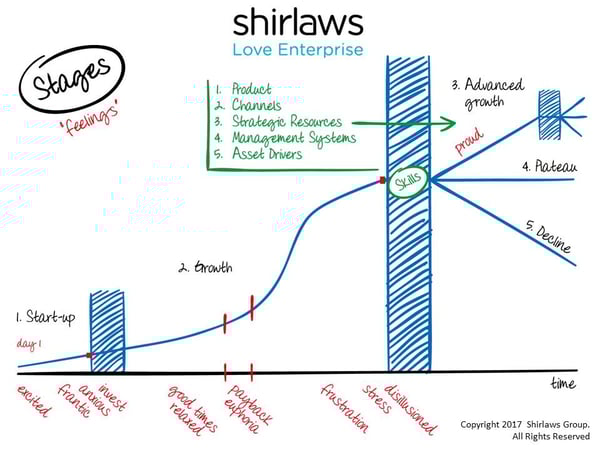
Start-up literally refers to where every business begins. At this phase as an entrepreneur you're likely wearing all the hats in the business, namely:
Often you may find yourself performing all these roles all at once. Most founders will spend a lot of their time trying to generate income. After all without customers there's no business. Often that then means many financial processes take a secondary seat.
Sure, you may still be using spreadsheets and you may be checking your bank balance but that's not the same as reviewing your financial reports.
You may also be wondering as to what are the kinds of questions you should be asking yourself about the business.
Again, that's completely normal.
You're likely to feel a range of emotions in the early days including;
Understandably your focus at this point won't be about building a large organisation. You're trying to create a business that works.
This means thinking carefully about:
Rarely, if ever, is anything perfect in life and that applies to these decisions. But they do deserve time and thought because they'll influence many of the decisions you make later on.
We find a huge misconception about staring a business is that robust financial systems can wait! Sure, you're unlikely to need a complex structure of reporting from day one. But you do need to build good habits and these include:
Do any of these statements sound familiar?
| ✔ You're making almost every decision yourself | ✔ You're focused on winning customers before anything else |
| ✔ You check your bank balance more often than your profits | ✔ You're concerned you might be missing something important |
If they do resonate then you're likely exactly where many successful business owners once were. The objective isn't to have absolutely everything figured out. It's instead about building solid foundations that will support the next stage of your business journey.

If you refer back to the stages diagram, along the way something changes:
Maybe you're then looking to employ someone, move into a new premises, buy equipment, or invest in better systems. Perhaps you'll look to pay yourself properly. At this exact phase you're likely to hit what we refer to as the first brick wall.
It's not a crisis, it's actually a decision point.
You now have a decision to make about whether to invest in the future of your business.
At the brick wall confidence starts to replace uncertainty but this new found confidence also brings questions.
| ✔ Can I afford to make this investment? | ✔ Will this lead to more customers, will they actually come? |
| ✔ Should I borrow this money? | ✔ Have I now outgrown the way I was running the business? |
Many founders have described this stage as feeling both exciting and unsettling at the same time.
It's at this phase where planning becomes more important than simply doing more work and grinding even harder.
So, you may need to thing strategically about:
It's at this point that we find that your financial systems will likely need reviewing and maturing. Simple bookkeeping is unlikely to be enough on its own. The way you've managed your finances so far is likely to have worked to get you to this point.
The next stage is likely to require something different. You'll now probably benefit from, and need to consider:
As you stand on the cusp of your first major investment decision, consider the following questions:
| Do I understand how much cash my business generates? | What systems can save me time and money over the next 2+ years, not just this month? |
| Can I afford to make an investment without placing unnecessary pressure on cash flow? | Where are the gaps in the business, what do we need to outsource? |
| Am I making decisions based on information or instinct? | Who is helping to challenge my thinking and assumptions? |
For some entrepreneurs the biggest investment isn't in equipment or premises. It's in improving the decisions they make.
Though it might look like it from the outside, it's probably a myth that successful businesses keep getting bigger. In reality, successful businesses evolve and the founder evolves with them. Decision making changes too.
Here's the important part, the financial information needed to make those decisions progresses as well.
Wherever you are on your journey, understanding what's likely to come next can help you make better decisions today for tomorrow.
That's why it's so important to plan and implement things around the following areas:

This post was created on 03/08/2026 and updated on 10/08/2026.
Please be aware that information provided by this blog is subject to regular legal and regulatory change. We recommend that you do not take any information held within our website or guides (eBooks) as a definitive guide to the law on the relevant matter being discussed. We suggest your course of action should be to seek legal or professional advice where necessary rather than relying on the content supplied by the author(s) of this blog.


leave a comment -