


You’ve filed your tax return. You’ve seen the number. Now comes the part no one enjoys, actually paying the bill!
This is a crucial concept and mechanism you need to understand, especially if you’re self-employed, a landlord, or where your tax isn't deducted at source. It’s called payment on account and it can catch people off guard.
By reading this blog you'll find out what this means, how it works, and how you can avoid being potentially stung by an unexpected balancing payment. Most importantly, you'll also likely understand how HMRC have calculated the bill that's presented on the final page of your return.

In this post we cover specifically:
Payment on account applies, potentially, to people in the UK self assessment system. It's HMRC’s way of asking you to pre-pay next year’s tax, based on this year’s bill. It’s split into two instalments with one due in January and another in July. Each one is typically 50% of last year’s total tax bill.
If next year’s tax bill ends up being higher, you’ll also pay a “balancing payment” which is there to make up the difference. This is all meant to help you stay ahead and not end up owing HMRC. If you’re not prepared through it can feel like double taxation.
So, if less than 80% of your income is taxed at source, HMRC assumes you’ll owe again next year. They then ask for part of it upfront. That is the concept of POA, it applies to people who don't have most of their tax deducted before they get paid. This means it's particularly relevant to:
So far reasonably simple, but there are many aspects and rules to this and that means it can get quite complicated. This is why you need a good understanding of all this in order to:
HMRC splits your tax bill into 2 significant advance payments:
Doing so spreads your payments out over the course of the calendar year. It helps the Exchequer too. They receive, in effect, a forward payment by the summer. If you owe £50,000 in tax for the first time under self assessment for the 2025/26 tax year then HMRC expects £25,000 by 31 January and the remaining £25,000 at the end of July.
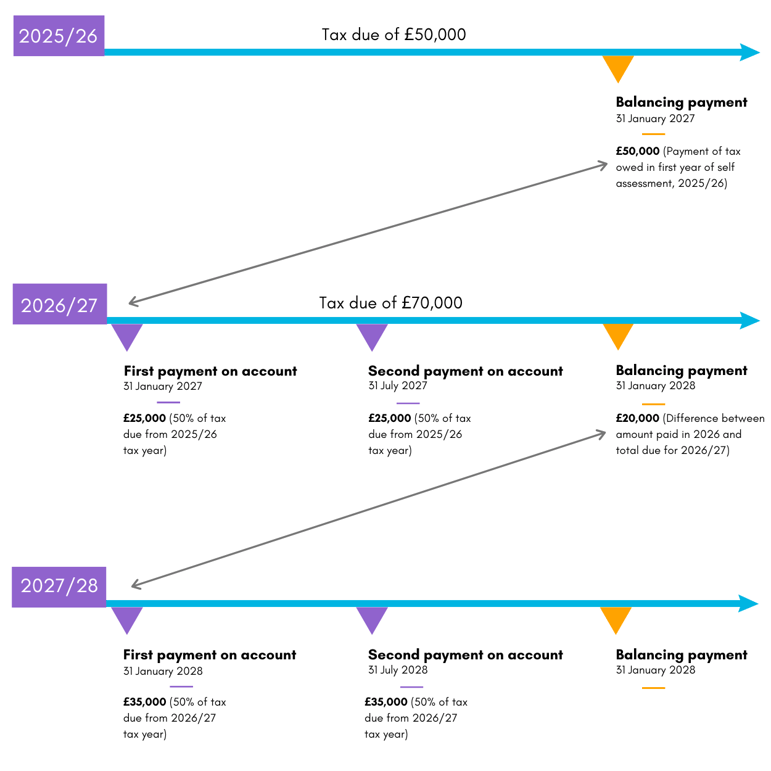 Unfortunately there's a catch. Remember these aren't payments for the year you've already filed. They're advance payments for the next tax year. That's where confusion can arise as you can feel like you're being asked to pay twice.
We'll use an example to help you with this. Be sure to reference the diagram to aid your understanding.
Tom is a IT contractor and per the prior section his first full year of self assessment was a really good one.
The total tax he owes for 2026/27 is £70,000 based on his 2025/26 tax return. That means he has an outstanding balance of £20,000 which is calculated on the £70,000 owed minus the £50,000 paid by 31 July 2027. This is the balancing payment and it's due for Tom on 31 January 2028. He'll also owe his first payment on account for the next year on that same date.
This means January can be a financially brutal month unless you're prepared! So, it's absolutely vital that you understand the cash flow impact.
Not everyone gets dragged into this system.
You won’t have to make two payments in the year if:
This is likely to be the case if you're both employed and self-employed. This means you could have a full time job but also be a part-time freelancer with most of your income coming through your employer.
If you’re fully self-employed, a landlord, a director taking dividends, or someone with unpredictable income—chances are, POA will probably apply to you.
If your income drops from one year to the next then you'll look to reduce POA. Maybe you lost a big client, took a career sabbatical, or had a normal year after a bumper one. Where this is the case then you can ask HMRC to reduce POA.
But here's the key:
Reducing excessively means you can end up owing more later! HMRC can hit you with potential penalties and interest charges for any shortfall.
It can become problematic if you earn a certain amount of income one year and this then drops significantly the next. But then it's not unusual for income to fluctuate in business so you may well be confident that your tax bill will be lower than the prior year.

Example, the risk of guesswork!
Pam, a freelance interior designer had a record-breaking 2024 with clients. Her mistake was to assume this was a one-off and that it couldn't possibly continue. So, she applied to reduce her 2025/26 POA.
But it turns out that while her income dipped, it wasn't by anywhere near as much as she expected.
The result was she ended up underpaying by £6,000. This meant by January she owed the balance and interest on top. Whilst not a huge amount it did have an impact on her finances.
The lesson is it's fine to reduce but only do so on solid income and earnings evidence!
How to do it
Online: Log into your HMRC account, go to your latest return, and choose 'Reduce payments on account.'
By post: Fill out form SA303 and send it to HMRC.
Either way, you’ll need to explain why your next bill will likely be lower. Don’t low ball just to improve short term cash flow!
POA need not hurt, so long as you set sufficient money aside for it. Generally in our experience the ones who suffer the most aren't necessarily those with the big bills, but those who didn't see their bill coming.
As a suggestion, if you're self-employed or running a business, adapt a mentality whereby you treat your tax money like it's not yours. If you think about it, it isn't.
Example, sound budgeting in action!
Rachel runs an expanding laundry business and she set up a second bank account to put some of her earnings aside for personal tax.
Every time she got paid out of the business, she moved 30% straight into that account, there were never any exceptions.
This meant when January came and she had to make her first POA and balancing payment, there was no stress, she had the cash ready. In fact she was able to give herself a bonus as she'd saved some extra.
Saving into a separate account can provide real peace of mind.
Suggested steps
Top tip:
Be sure to save based on what you'll owe. Your tax bill reflects your profit extraction, not your top-line income. So budget smart by checking what you're actually taking home.
You've done the maths, you've set money aside, and now it's time to make payment.
Below we detail how you can pay HMRC.
Payment methods:
Importantly, and per the above, not all payment methods process at the same speed!
| How long each payment type takes | |
| Method | Time to clear |
| Online banking and CHAPS | Same day |
| Debit card | Usually the same day |
| BACS and Direct Debit | 3 Working days |
| New Direct Debit set up | 5 Working days |
| Cheque | Risky, impossible to say |
If the deadline falls on a bank holiday weekend then you need to make sure that your payments clear by the last working day before.
Our advice is pay early where possible and know your method and related timings.
Being tax efficient is a process that starts with your tax return. Be sure to read our post about how to be better prepared for your online tax return. Waiting until January is akin to procrastination and sacrificing your peace of mind. So, look to file early for planning purposes and to help control your finances.
Here's how you benefit when you file early:
a) You get your bill sooner
So you can plan for making payment, as opposed to scrambling for funds at the last minute.
b) Your get potential refunds sooner
If you've overpaid then the more promptly you file, the earlier the refund is likely to be paid into your bank account.
c) Pay through your tax code (where relevant)
If your bill comes in under £3,000 and you file before 30 December then you may be able to spread the cost through PAYE meaning no big cash hit in January.
d) Avoid the January madness
We find many people leave things to the last minute when it comes to tax returns. The result is HMRC's phone lines are jammed, and accountants are swamped. This means mistakes can happen while any late submissions result in fines.
Example, breaking bad habits
Jennifer, a freelance PR consultant, had a terrible tendency to submit her return on 30th January, always very close to the deadline and only finding out what she owed last minute. It had the effect of ruining her start to the year and could cause anxiety as to what the payment could be.
Then one year she took advice and filed in June. It made her feel like a financial adult as she now knew what she owed, and she had over half a year to prepare for paying it. This also brought to an end her post-Christmas emotional slump over the state of her finances.
| 1. | Send through all relevant tax return information to your advisor as soon as possible |
| 2. | Check the total tax amount due through your account with HMRC online services |
| 3. | Note the first and second POA dates in your calendar/diary |
| 4. | Set up a payment method with HMRC |
| 5. | Set aside regularly a proportion of your income in a separate account for the tax you owe |
| 6. | Check that the correct amount has been paid to HMRC before the deadline dates |
This post was created on 29/07/2016 and updated on 28/01/2026.
Please be aware that information provided by this blog is subject to regular legal and regulatory change. We recommend that you do not take any information held within our website or guides (eBooks) as a definitive guide to the law on the relevant matter being discussed. We suggest your course of action should be to seek legal or professional advice where necessary rather than relying on the content supplied by the author(s) of this blog.


leave a comment -