A practical guide for owner-managers to scale their business with better financial advice, commercial insight, and strategic support.
Getting to a stage of growth is often what many business owners work tirelessly to achieve.
It means more customers, more revenue, and more opportunities.
But for many owner-managers it also becomes a point where running your business feels so much harder than it did before.
Cash flow can become tighter despite rising sales. The challenge of recruiting and retaining good people often increases. Decisions end up carrying far greater financial consequences. Furthermore your systems that once worked so well can begin to crack under the pressure that comes with expansion.
This is also the stage where many businesses discover that the advice that them helped them through their start-up journey isn't necessarily the advice they need now to keep growing.
That's why we've written this content, to explain:
- How growth creates a new and different set of challenges
- What your accountant should do to support you and your business
- How to recognise you've outgrown your existing advisor
- How changing accountants can work if you've decided that the time is right
Here are some quick links to the various sections covered by this page:
Growing your business, why does success feel harder?
We've found that a common assumption, and a misconception, of many owner-managers is that growth will automatically make your life easier.
Unfortunately the reality is the opposite is likely.
The early stages of building your business typically see success characterised by a great product or service, winning new customers, and often a lot of hours of incredibly hard work. However, as your business expands those same approaches may no longer be enough on their own.
You may find yourself managing a larger team, having to make significant financial decisions, needing to invest in new systems and processes, recruiting people into senior roles, and even expanding into additional offices. As revenue increases, so do the risks and responsibilities that come with it.
It's often at this very point that most owner-managers tell us this is the point where they stop feeling like a founder of a small business and start feeling responsible for an organisation where other people's lives depend on the very decisions they make.
Sure it's exciting, it's rewarding, but it can be all those things and very stressful at the same time. The good news is that's perfectly normal.
Growth doesn't just require more of your effort. It needs different skills, insightful financial information, robust systems, and advisors who can help you make assured decisions that help your business develop and evolve.
You're not alone as most growing businesses experience this transition
Many business owners assume they're the only ones finding growth more challenging than they expected. In reality, it's a well-recognised stage in the business lifecycle.
The Shirlaws Business Lifecycle Model below illustrates how businesses typically progress through different phases of growth. While every business is unique, many owner-managers recognise the shift from the excitement of early success to the increased complexity, responsibility and pressure that come with expansion and scale.
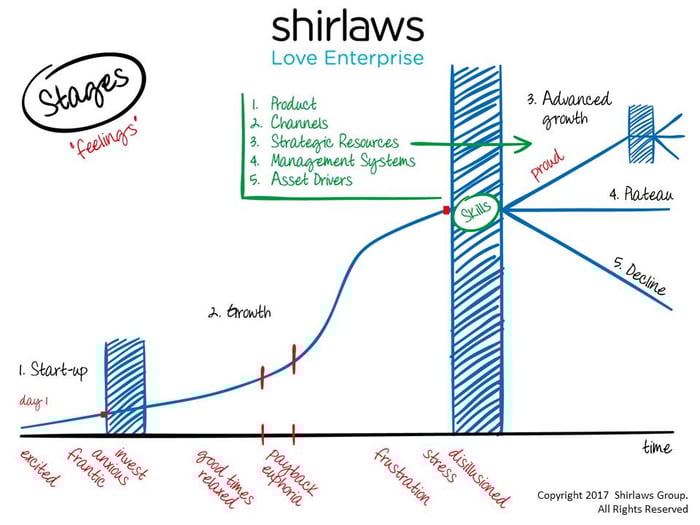
If you're beginning to recognise where your business sits on this journey, you're not alone. The next sections explain how the right financial advice can help you navigate the growth phases with greater clarity and continue building a business that can keep growing.
Is your accountant helping your business grow?
Many accountants are excellent at helping their clients stay legal and compliant. A case of preparing annual accounts, submitting tax returns, managing VAT, payroll, and keeping HMRC happy.
Of course they're important parts of running a business successfully. But the bigger question to ask yourself is, are they enough for where your business is at today? Are you prepared for growth?
As your business expands, the conversations you'll need to have with your accountant will change. You likely won't just want to look backwards at last year's accounts, you'll now need help answering questions such as:
- Do we have sufficient cash coming in to support our growth?
- Are we in a financial position where we can recruit more people?
- Can we continue to fund growth ourselves, or do we need to raise finance?
- Which parts of the business are making money, and which aren't?
- What are the systems we need before we expand further?
- Is the business we're building likely to be enticing to investors or future buyers?
These aren't just accounting questions. They lead to commercial decisions based on performance data, and they're likely to have financial consequences.
That's why many growing businesses look for an advisor who can do more than explain what happened last year. They need someone who can help them better understand the potential consequences of options and decisions. Like you, they want to understand what's likely to happen next.
The role of an accountant doesn't become less important as a business grows, if anything it becomes more valuable.
What should an accountant do for a growing business?
As your business scales, so too should the support that you receive.
As we've said, preparing annual accounts and tax returns remains important, but they're just a part of the overall picture. Growing businesses generate bigger decisions, and those decisions require better financial information along with advice.
A good accountant will help you look forwards, not just backwards.
Looking forward may look as follows:
- Forecasting profits and cash flow so that you grow without running out of money
- Ascertaining which products and services are the most profitable
- Producing management accounts to help you make better informed decision throughout the year
- Build meaningful Key Performance Indicators (KPI's) to help track progress
- Planning for tax efficiently rather than just reporting what has already happened
- Raising finance by preparing the financial information lenders and investors expect to see
- Introducing systems and processes that can support sustainable growth
- Helping you to build value in your business should you one day look to attract investment or sell
It's worth remembering that as your business becomes larger so your financial decisions become more interconnected. Recruiting another employee may affect cash flow. Investing in new premises could influence funding requirements. Expanding into new territories can bring new potential tax considerations.
That's why it's likely to be so worthwhile having an accountant on board who understands how these decisions interact meaning they can help you move forward with confidence.
At Wellers we refer to this relationship as 'Business Oxygen'.
It's not that we think accountants should run your business, but good financial advice can help remove uncertainty, improve decision making, and provide you with the conviction to focus on the key areas of building the business you've worked so hard to create.
How do you know when you've outgrown your accountant?
Most businesses don't just decide to change accountants overnight.
In many cases we find the relationship had worked well for many years. Your accountant is likely to have helped you set up your enterprise, navigate the early days of trading, and kept your finances in order.
Unfortunately as your business evolves, so the dynamics alter, and that means your expectations naturally change.
The advice that may have worked for a business turning over around £250,000 is likely to not be enough for one that's turning over £2m. That doesn't mean that your current accountant has done anything wrong. It may simply mean that your business now needs a different, enhanced level of support.
Consider this, you may have outgrown your accountant if:
|
Conversations are historic rather than future focused
You understand what happened through last year's accounts, but you don't receive much insight or advice as to what might be coming next.
|
Rarely receiving practical ideas or recommendations
Good advisors won't just answer questions, they'll spot opportunities from their experience of advising other clients in similar circumstances. They'll see risks you hadn't considered too.
|
|
You only hear from your accountant when there's a deadline to meet
Growing businesses often benefit from regular conversations throughout the year, not just at year-end.
|
Reporting no longer gives you the information you need
Annual accounts have their place, of course, but if you're expanding then you're likely to need management accounts, forecasts, and KPIs to help make timely decisions.
|
|
Making important decisions without financial insight
Whether you're recruiting, investing, borrowing, or implementing an expansion, you should feel able to discuss those decisions before you commit to them.
|
Looking elsewhere for business advice
Are you turning to lenders, consultants, networking groups, online authors, or other business owners for financial guidance? Maybe your accountant should have more of a role in strategic direction.
|
None of these points mean you should change accountants automatically.
If several sound familiar, maybe it's time you considered whether your current relationship properly supports you in the next stage of your business growth journey?
Is it working as well as it did in your earlier growth phase? Sometimes the clearest sign you've outgrown your accountant is that your business has simply outgrown the service you originally needed.

How can the right accountant help you scale your business?
At a certain stage in your growth cycle, scaling up becomes more than simply increasing sales.
As an owner-manager, you're looking to make the right decisions at the right time. This could be for:
- Recruiting your first Manager
- Investing in new technology
- Opening in another location
- Exploring overseas markets
The point is each decision carries financial implications. That means having access to clear, timely advice that can help make those decisions easier whilst also reducing the risk of costly mistakes.
A proactive accountant is likely to become part of your wider support network, helping you to look beyond just being compliant so as to also focus on the future.
What does this look like? It could mean:
- Understanding if your cash position can be used to reinvested for growth
- Forecasting the financial impact of major investments before you commit to them
- Identifying strategies to improve profitability and strengthen cash flow
- Establishing robust financial information for applications for finance or when seeking investment
- Developing reporting that give you confidence in your decision making
- Planning ahead for significant milestones such as:
- Acquiring another business
- Expanding internationally
- Preparing for a future exit
Only you can make the decisions, the advice can't do it for you. But a good advisor can provide you with the financial clarity to make those decisions more confidently.
Growth can be a very challenging time in a business, there's a lot of moving parts and dynamics. Having someone who understands both the numbers and your long-term aspirations can help move you forward with a greater sense of certainty whilst also enabling you to focus on what you do best, running your business.
Why businesses value this approach
Many owner-managers inform us that what they value most isn't having all the answers. It's having someone on hand where they can pick up the phone to them before making an important decision. Someone who understands their business. Someone who challenges their thinking when it's required and can explain complex financial issues in clear and plain English. That's all coming from an advisor and financial mentor who wants their business to succeed as much as they do.
Isn't that that the kind of relationship owners of growing businesses are looking for as they move into the next phase of growth?
When is the right time to change accountants?
Like many things, there's rarely a perfect time to change accountants.
Many business owners assume they should wait until the end of their financial year, after submitting their accounts or once major project has been finished.
We'd suggest that if your business has reached a point where you're no longer receiving the advice and support you need, then delaying this decision simply means missing out on more potential opportunities and maybe even continuing to make important decisions whilst lacking the necessary performance insight.
We find growing businesses often change accountants when they:
- Need more practical, commercial advice
- Have outgrown the firm and level of service they have received
- Require better management information to support decision making
- Are raising finance or planning to take on investment
- Are expanding into new markets, locations, or introducing more complex business structures
- Need an advisor who can support their long-term ambitions not just meet compliance
So perhaps consider that maybe the best time to change accountants is when your business needs the change, not when the calendar tells you to.
If you're at that stage where you're wondering whether your current advisor is the right fit for where your business is now at, it's probably worth exploring your options sooner rather than later.
How to change accountants without disrupting your business?
One of the biggest reasons owner-managers delay changing accountants is due to the fear that the process could be complicated, time-consuming, and even disruptive.
However, changing accountants is actually much simpler than many people expect.
Your new accountant (when you select them) will handle most of the transition on your behalf, they will
- Contact your previous accountant
- Request the necessary financial information
- Make sure professional clearance procedures are adhered to
Their aim is to help make the process as smooth as possible. That way you can continue focusing on running your business. Whilst every situation is likely to be different, the typical steps to this process include:
- You choose your new accountant
- You sign a letter of engagement
- Authorise your new accountant to contact your existing advisor
- Financial records and relevant information are transferred over
- You agree the level of ongoing service and support your business needs
The process is designed to minismise disruption whilst also ensuring that statutory obligations continue to be met throughout the transition process.

Why growing businesses choose Wellers
Owner-managers often reach a point where keeping up is no longer enough.
As challenges become bigger and more complex, your decisions will likely carry greater weight. The opportunities may be bigger, but the risks scale as well.
Our philosophy at Wellers is that accountancy support and advice should evolve alongside your business. So, we provide the compliance services your business needs whilst also offering the commercial insight and strategic advice that a growing business will increasingly need and rely upon.
Out clients value having us as advisors because we take the time to understand their ambitions, explain financial issues and challenges to them in plain English, and provide them with practical advice based on many years of experience helping business owners reach decisions with confidence.
You may be recruiting, investing, seeking funding, improving profitability, or shifting into a phase of fast growth, our role is to ensure you see the bigger picture so that you can make informed decisions based on reliable financial information.
Good advice for us starts with obtaining an in-depth understanding of you and your business.
Every business has different goals, challenges, and opportunities. That's why we focus on building long-term relationships by giving our clients the knowledge and support that is so vital and necessary to enabling their businesses to grow.
Why work with Wellers
- Experienced advisors with a track record of understanding and helping growing businesses
- Practical, jargon-free advice that's tailored to your goals
- Proactive support throughout the year, not just at year-end
- Access to specialists across tax, audit, payroll, corporate finance and business advisory
- A long-term relationship geared to helping you and your business thrive
Business Oxygen
As businesses expand, access to insightful financial information and advice becomes increasingly valuable. We refer to this as 'Business Oxygen'.
This is all about providing owner-managers with exactly what they need to make informed decisions, navigate a fast changing world, whilst keeping their business moving forward with clarity.
They key is when you can see where your business is today, and where it clearly can get to tomorrow, then you're likely to be able to make better decision for your future.
How to build a business that can keep growing
Every business will reach important milestones that shape it's future.
This could be investing in new technology, winning a large contract, or even planning for an eventual exit. The point is these decisions bring both potential opportunity and added complexity.
In our experience, the businesses that continue to grow through such circumstances aren't those that necessarily have all the answers from the outset. They're likely however, to be surrounded by people who ask challenging questions to help them think through the potential implications of decisions as they move forward.
That's exactly where trusted advisors by your side can make a real difference.
Having access to timely financial information, practical commercial insight backed by experience, and advisors who understand your ambitions can provide you with the confidence you need to plan ahead. That's proactive and likely far better than reacting to events as and when they happen.
Often growing a business isn't about reaching a finish line, it's about continually improving and building something stronger that's ready for whatever may come next.
Your next steps
If you've recognised some of the challenges we've described in this guide, then it may be time to have a conversation about what your business needs to reach the next stage of growth.
That may not mean changing accountants immediately. But it does mean understanding what good professional support looks like and deciding whether your current advisor is enabling you to achieve your ambitions.
If you talk to us you'll see that we take the time to really understand you and your goals, we will empathise with the challenges you face and that will enable us to help recommend the most appropriate options for moving things forward.
Whether you're looking for a fresh perspective, more proactive advice, or a long-term partner to support your growth, we're here to help.

FAQs
When should I change accountants?
The best time to change accountants is when your business has outgrown the support your receiving. You may be looking for more proactive advice, better financial insight, or strategic guidance to support growth aspirations. If this is the case don't wait until your financial year end would be our advice, start exploring your options.
What are the signs I've outgrown my accountant?
You may have outgrown your accountant if your conversations with them focus mainly on historic performance and not your future plans, if you rarely receive proactive advice, or if you're making decisions without much financial data or guidance. As your business grows, so your accounting and strategic needs will become more sophisticated.
Is changing accountants difficult?
Often this isn't the case. Your new accountant will typically manage most of the transition whereby they will contact your old accountant and request the necessary information for a smooth handover. The process should be reasonably straightforward and cause minimal disruption.
Can I change accountants during my financial year?
Yes, you can change accountants at any point during the financial year. Many businesses do so when they need additional support, rather than waiting until their year-end.
Will changing accountants affect HMRC?
No, changing accountants shouldn't affect your relationship with HMRC. What will happen is your new accountant will sort out the necessary authorisations so that they can act on your behalf (where necessary) to manage your tax affairs.
Will my new accountant contact my old accountant?
Only with your permission will your new accountant get in touch with your previous advisor. This will be to request professional clearance and obtain the necessary information needed to ensure a smooth transition.
How much does changing accountants cost?
Pricing and investment will depend on the complexity of your business and the level of support and services you need. Most accountants, including Wellers, discuss fees and provide quotes up front so that you understand exactly what's included before you commit to making a decision.
How long does changing accountants take?
Many businesses complete this process within a handful of weeks. Timescales can vary depending on size and complexity of your business and how quickly information needs to be transferred between advisors.
What information will my new accountant need?
Your new accountant will usually request:
- Recent accounts
- Tax information
- Accounting records
- Relevant business documents
Most of this information is likely to come from your previous accountant so it should be a relatively straightforward process.
What should I look for in an accountant as my business grows?
You'll need an accountant who:
- Understands your business and ambitions
- Can provide proactive advice throughout the year
- Communicates clearly and effectively
- Provides financial insight to support strategic decision making
- Is committed to delivering more than just year-end compliance
How can an accountant help a growing business?
A good accountant can help you:
- Project your likely future profits
- Forecast cash flow
- Strategise as to how to improve profit margins
- Produce meaningful management information
- Support funding applications
- Help you build value into your business for a future exit event
- Provide strategic advice to help enable growth
Do growing businesses need management accounts?
Management accounts aren't a legal requirement like annual accounts. However, many growing businesses find them invaluable. The reason is they provide you with regular financial information throughout the year and this can help you monitor key performance metrics, and gauge success concerning things such as profitability and cash flow. Understanding performance can then help you make better informed business decisions for the future.
Can't see your question?
Visit our blog and knowledge hub for more practical information on growing your business, changing accountants, cash flow, tax planning, and business finance. Be sure also to get in touch with our team.
Please also be aware that information provided on this page is subject to regular legal and regulatory change. We recommend that you do not take any information held within our website or guides (eBooks) as a definitive guide to the law on the relevant matter being discussed. We suggest your course of action should be to seek legal or professional advice where necessary rather than relying on the content supplied by the author(s) of this website.